
Will industrial vision engineers be replaced by prompt engineers?
ndustrial vision is shifting from "human→rules→machine" to "human→language→machine." Vision foundation models and zero-shot defect detection let engineers simply describe "find suspected oxidation," and the machine understands anomalies itself. But prompt engineers won't replace vision engineers—the hard part is context: false welds, oxidation, reflections and tolerances known only to those on the
The Most Important Capability for Industrial Vision Engineers May Become "Speaking Human"
Can you believe it?
In a few years, the most important capability of an industrial vision engineer may not be whether they can adjust lighting, nor whether they can write algorithms.
But rather –
whether they can "speak human."
Recently, two very interesting developments have appeared consecutively in the industrial vision field.
One is the release of the industrial vision large model dataset MMIOC-1M; the other is that more and more teams have begun researching Zero-shot industrial defect detection.
Translated into plain language:
In the past, to make a machine find defects, you first had to teach it what a defect is.In the future, you only need to tell it:"Help me find areas around solder joints suspected of oxidation.""Filter out all parts whose shapes differ significantly from normal samples.""Focus on locations with burrs, cracks, and colour anomalies at the edges."And it can understand and judge on its own.
What does this mean?
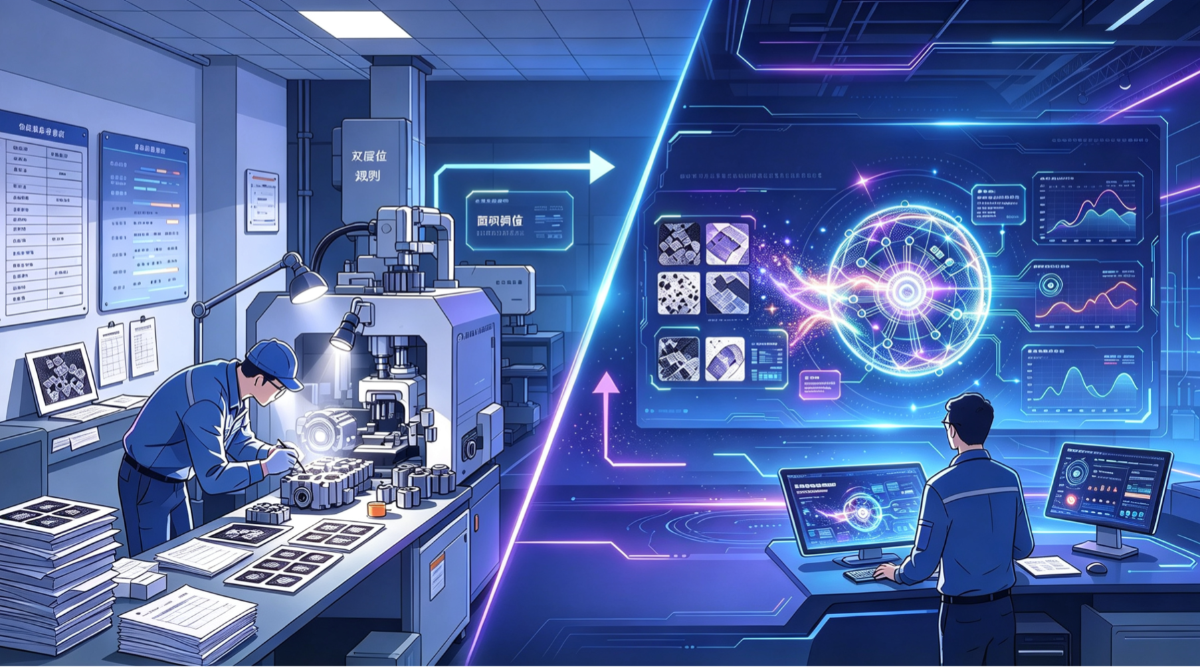
It means industrial vision may be undergoing its biggest paradigm shift in the past twenty years.
01The Past: Translating Human Experience into Machine Rules
In the past, how was an industrial vision project done?
The customer says: "Help me inspect this part."
Engineers first go to the site.
Choose cameras, lenses, and light sources.
Set up lighting, capture images, label, adjust thresholds, write rules, train models, and optimise parameters.
Then wrestle with the site conditions.
A missed detection today, a false detection tomorrow.
Product changes batch – readjust.
Supplier changes material – readjust.
Change to another production line – readjust again.
Many vision engineers mock themselves:
"I'm either adjusting parameters or on my way to adjust parameters."
Why?
Because traditional industrial vision is essentially:
translating human experience into machine rules.And this translation process is slow, expensive, and dependent on experts.
But after large models arrived, the rules of the game changed.
In the past: human → rules → machine.In the future, it may become: human → language → machine.
You no longer need to define: "grayscale value greater than what."
Nor do you need to specify: "area smaller than what."
You don't even need to prepare a large number of defect samples in advance.
Instead, you directly tell the system:
"Circle out all the places that don't look like normal products."
The machine begins to understand the concept of "anomaly."
This is the recently hot topic: vision large models.
02Prompt Engineers Will Not Replace Industrial Vision Engineers, but Industrial Vision Engineers Must Learn Prompting
Seeing this, many vision engineers may panic.
Will vision engineers no longer be needed?
The answer is exactly the opposite.
Prompt engineers will not replace industrial vision engineers, but industrial vision engineers must learn prompting.
Why?
Because what is truly difficult in industrial vision has never been the model.
But rather the scenario.
For example.
Inspecting the same solder joint.
You know when it is a cold joint.
When it is oxidation.
When it is merely reflection.
When the customer says "inspect everything" but actually allows certain tolerances.
This knowledge, large models do not know.
Internet companies do not know either.
Only people who have long been immersed in the production line know.
So the truly valuable people in the future are not those who can only tune models.
Nor those who can only write prompts.
But rather:
people who understand both processes and AI.
They know how to describe the problem.
They know which defects must not be missed.
They know whether false detection or missed detection carries a higher cost.
They know that what the site truly needs is not 99.99% accuracy, but ROI.
To put it plainly:
Vision engineers of the past were teaching machines "how to see."Vision engineers of the future are teaching machines "how to understand."
It seems like just one extra word.
But behind it is a reconstruction of the entire industry's capability model.
03This Change Is Not Limited to Industrial Vision
What is even more interesting is that
this change is not limited to industrial vision.
MES, equipment monitoring, and industrial control are all undergoing the same thing.
In the past: people who could write code were the most valuable.In the future: people who understand the business, understand the scenario, and can also orchestrate AI will be the most valuable.
AI has lowered the technical threshold.
But it has raised the threshold of industry cognition.
04What Is Truly Eliminated Has Never Been a Profession
So, will industrial vision engineers be replaced by Prompt engineers?
The answer is:
No.
But in the next three to five years, industrial vision engineers who cannot use AI may be replaced by peers who "understand vision, understand processes, and also understand prompting."
What is truly eliminated has never been a profession.But an old way of working.
If you work in industrial vision,
which part of your current work would you most like to eliminate?
Is it lighting?
Is it labelling?
Or is it the endless parameter tuning?