

Why is MES so difficult to implement?
On the surface, MES seems to be just a few functions — production reporting, quality traceability, and equipment data collection. Yet in practice, implementation often takes six months, a year, or even longer. Why? Because the hardest part of MES has never been software development. It is the challenge of truly translating a factory that runs on people, experience, and Excel spreadsheets into a co
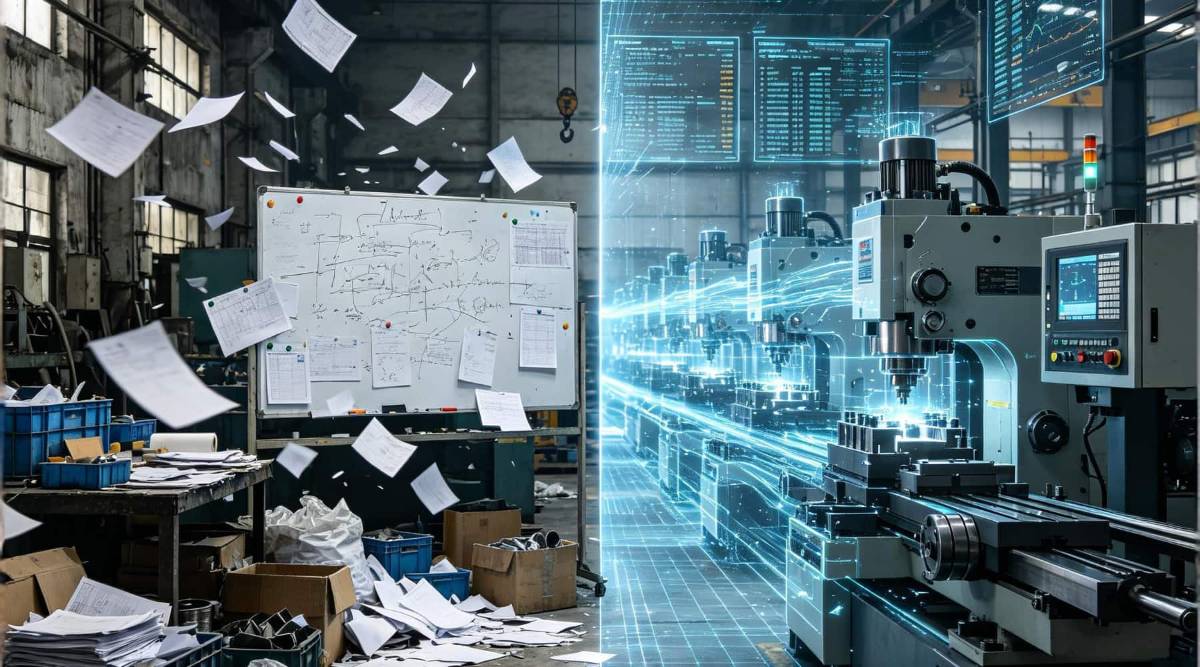
Why is MES implementation so difficult?
Anyone who has worked with MES probably shares one feeling:
The hardest part of MES is not development – it's implementation.
The software interface doesn't look that complicated.
Production reporting, work order management, quality traceability, equipment data collection, dashboards...
But out on the shop floor, it is perfectly normal for a project to take six months, a year, or even two years.
Why?
Because MES does something extraordinarily difficult:
It has to translate a factory that originally runs on people, spreadsheets, and experience into a software-driven process.
And that is where the problems begin.
01Challenge One: The Customer Doesn't Want MES – They Want "MES Done My Way"
Challenge one: you think the customer wants an MES, but what they really want is "MES done my way."
Take production reporting, for example.
Workshop A: report after the work order is completed.
Workshop B: report after each batch.
Workshop C: report after every 10 pieces processed.
Some companies have one process for rework, another for outsourcing, and yet another for trial products.
The software vendor says:
"Let's follow the standard process."
The customer says:
"This is how we do things on the shop floor."
And so the first battle of the project begins:
Should the factory adapt to the software, or should the software adapt to the factory?
This is why MES projects tend to become more and more customised over time.
02Challenge Two: Data in the System ≠ Data on the Shop Floor
Challenge two is even more troublesome:
The data in the system is fundamentally different from the data on the shop floor.
In the ERP, the material code is A001.
In the MES, it is called A-001.
In the warehouse, it is 001-A.
On the equipment, there may even be a code that only the master operator can understand.
Not to mention BOMs, process routes, units of measure, and process codes.
Inconsistent data definitions across different systems are one of the most common pitfalls in MES integration.
So many people think an MES project is about "developing software."
In reality, a significant amount of time is spent on:
reconciling codes, reconciling data, reconciling interfaces, and reconciling processes.
03Challenge Three: Equipment – The Headache for Software Vendors
Challenge three is the one that gives most software vendors a headache: equipment.
The customer says:
"We want automatic data collection."
It sounds simple enough.
But once you get to the shop floor, you find: this PLC is Siemens, that one is Mitsubishi, some legacy equipment uses serial ports, some equipment has no communication interface at all, and some equipment manufacturers don't open their protocols.
In the end, you will find that:
At the top is software, but at the bottom is a bunch of equipment you simply cannot control.
Moreover, once MES connects to equipment, the problem shifts from IT to IT+OT.
A poorly handled interface is not as simple as a web page failing to load.
It could mean:
data doesn't come through, production reporting is wrong;
status isn't captured, OEE is incorrect;
processes don't flow, the next operation cannot proceed.
So in some projects, equipment integration can consume a very large portion of the project budget.
04Challenge Four: The Hardest Part Is Not Technology – It's People
But the hardest part is actually none of the above.
The hardest part is people.
Before go-live, everyone thinks:
"This system looks good."
After go-live, operators start asking:
"Why did it take just one scan before, but now I have to click five times?"
Team leaders say:
"I used to just glance at the board and know today's output – why do I have to fill in so much now?"
Management says:
"I need real-time data."
But frontline workers are thinking:
"Don't increase my workload."
So you will find that:
An MES project appears to be a software project on the surface, but in reality, it is a production process reengineering.
Everything that used to be hidden in paper, Excel spreadsheets, and the minds of master operators is now moved into the system.
Once it is brought out, the underlying issues can no longer be hidden.
Who is responsible? Who approves? Who reports production?
What counts as "completed"? What counts as "qualified"? What counts as "rework"?
What exactly does equipment downtime count as?
These questions could previously be answered with one phrase:
"Handle it flexibly on the shop floor."
But not anymore.
The software must provide a definitive answer.
05The Essence of MES: Making the Factory Clear
Therefore, the hardest part of MES implementation is not building the software – it's making the factory clear.
If you don't even understand how the factory actually produces, it doesn't matter how well-written the software is.
This is why in many MES projects today, the deciding factor is no longer how many features the interface has – it is:
who truly understands the shop floor.
People who understand processes, people who understand equipment, people who understand production management, and people who understand software.
If any one of these four capabilities is missing, the MES project is likely to run into trouble.
In the AI era, this will become even more pronounced.
Because in the future, MES will not just record "what happened."
It will also need to answer:
Why did it happen?
What should be done next?
Which equipment is likely to fail?
Which order should be prioritised for production?
Which process step is this quality anomaly actually related to?
So the real competition in MES going forward may not be about who has more features.
It will be about who can truly connect:
orders, processes, equipment, people, quality, and data into a complete production closed loop.
Ultimately,
MES is not a software project.
It is more like a "digital health check" for the factory.
The software is just the layer that grows on top.
What is truly difficult is to understand, rationalise, and standardise the underlying production logic.
That is why MES implementation is so hard.