
Why is it so hard for industrial software to become "disposable software"?
Industry is least suited to full "disposable software." The closer to the physical world, the less disposable: protocols, real-time databases, permissions, processes and safety controls demand stability, traceability and continuous operation—a control-logic error can halt production. Yet factories face many temporary problems daily, and AI makes short-cycle problems economically software-able, spa
Industrial Software Will Not Become Fully "Disposable" – It Will Be "Stable Foundation + Disposable Applications"
Many people, when they hear "disposable software," instinctively assume:
in the future, all software will be like short videos – shot and used on the spot.
But if you have truly worked on industrial software – especially MES, SCADA, vibration monitoring, aerospace testing, and similar systems – you will discover –
the industrial sector may actually be one of the industries "least suited to full disposability."
Here is a particularly worth-discussing new trend:
in the AI era, not all software will become "disposable."
What will truly explode may be –
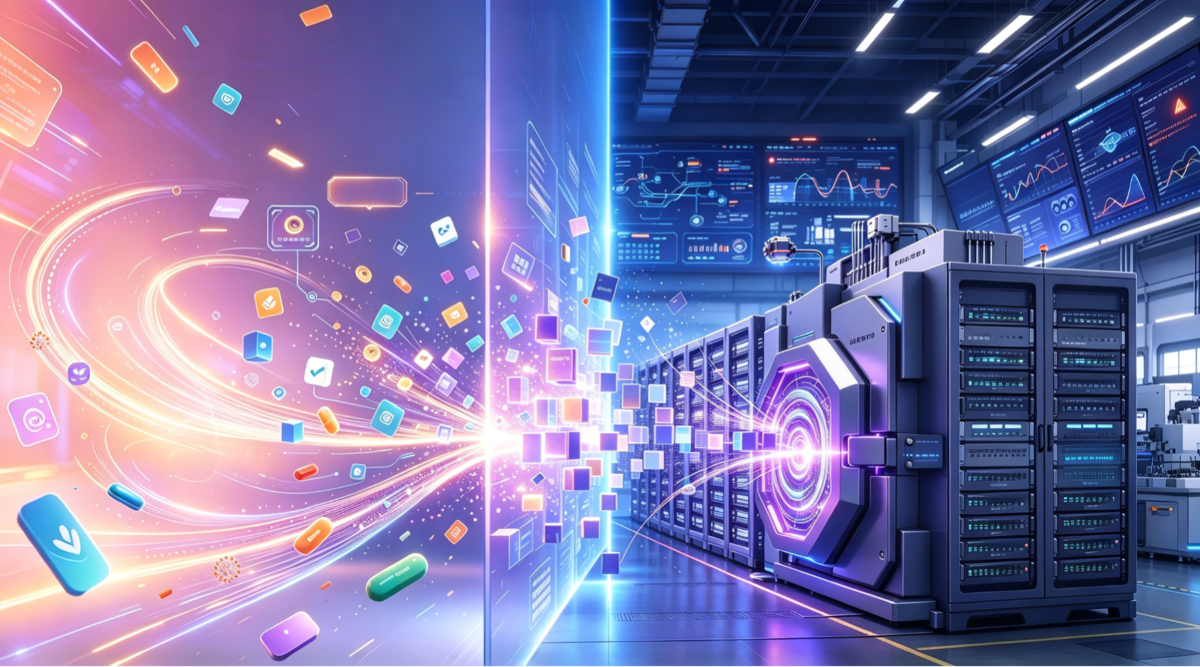
a two-layer structure of "stable foundation + disposable applications."
01The Foundation Is Getting "Heavier," the Upper Layer Is Getting "Lighter"
What does this mean?
Many people understand software as a complete, large system.
But future industrial software will likely begin to split.
The foundation is getting "heavier."The upper layer is getting "lighter."
For example: equipment protocols, real-time databases, permission systems, process flows, data acquisition, and safety control…
These things simply cannot be "disposable."
Because the core objective of industrial systems is not "speed," but:
stability, traceability, safety, and continuous operation.
If a livestream registration system crashes, the only loss is some traffic.
But if a production line control logic is wrong, it may directly stop production.
So industrial software naturally follows a physical rule:
The closer it is to the physical world, the less it can be "disposable."
This is actually a problem many AI bloggers overlook.
What they see is: AI can quickly generate interfaces.
But what is truly complex on the industrial site is:
timing logic, equipment interlocking, real-time performance, fault tolerance mechanisms, and abnormal conditions.
These things cannot be safely implemented with a single Prompt.
02The Industrial Sector Will Also Become One of the Industries with the Strongest Demand for "Disposable Software"
But interestingly –
the industrial sector will also become one of the industries with the strongest demand for "disposable software."
Doesn't that sound contradictory?
Because every day on the industrial site, there are a large number of "temporary problems."
After AI appeared, one change came:
These "short-cycle problems" have, for the first time, acquired the economic viability of being turned into software.
In the future, factories are very likely to see: "software with a 48-hour lifespan" born every day.
Note, this is not about the core MES being replaced.
But rather, on top of the MES, a large number of "temporary intelligent tools" will grow.
For example:
a temporary spectrum analysis page;
a dedicated traceability assistant;
an equipment anomaly diagnosis Agent;
an analysis system serving only one specific test.
Their lifecycle may be only a few days.
But their value is extremely high.
03The Foundation Gets Heavier, the Applications Get Lighter
So future industrial software will not necessarily become fully "disposable."
A new structure is more likely to emerge:
Core systems will become increasingly platformised and infrastructural;Peripheral applications will become increasingly instant, Agent-based, and temporary.
To put it plainly:
"The foundation gets heavier, and the applications get lighter."
This may be the true direction of industrial AI development.
04The Most Valuable Industrial Software Companies in the Future
So the most valuable industrial software companies in the future may not be the ones that "tear down and rewrite the entire MES."
But rather:
companies that can rapidly generate large numbers of temporary intelligent applications on top of a stable industrial foundation.
Because the biggest contradiction in the industrial sector has never been "whether there is a system."
But rather:
a large number of problems that, in the past, could never be turned into software in time.